

The world’s first and only patented Autologous Micrografting Technology (AMT®), designed to harness the body’s own regenerative potential through autologous micrografts prepared from the patient’s own healthy tissue.
How It Works
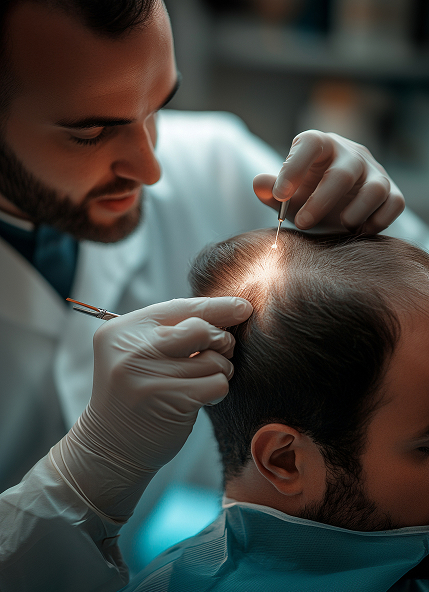
Autologous Micrografting Technology (AMT®) is a regenerative procedure developed around the patented Rigenera® device. It prepares an injectable autologous micrograft suspension from the patient’s own healthy tissue. with minimal manipulation, no chemicals and eliminating the risk of immune rejection associated with non-autologous materials..
The resulting micrograft solution contains the AMT® Triad: Progenitor cells that contribute to the regenerative microenvironment surrounding the hair follicle, up to 70 billion with EVO autologous and homologous smart exosomes, and extracellular matrix all derived from the patient's own biology.

Tissue-specific cells capable of differentiating into follicular stem cells, reactivating dormant follicles.

Up to 70 billion with EVO autologous & homologous exosomes per session – the cell communication signal that support cell-to-cell communication involved in regenerative signaling.

The biological scaffold that supports cell migration and follicular tissue restoration.

Regenera Activa holds the highest European and international certifications, reflecting our unwavering commitment to patient safety and clinical excellence.




An average of 5,233.9 ± 521.9 cells in 1.1 mL.
The number of cells is not important in autologous point of care treatments.
The number of cells depends on different factors and each individual.
Regenera Activa is a tissue-specific, cell-based solution in a single session, with minimal manipulation. Micrografts deliver viable mononuclear regenerative cells, their secretome (growth factors, cytokines, exosomes) and ECM fragments, all in their native state and relevant to the hair follicle environment.
Regenera Activa delivers tissue-specific and autologous exosomes.
Yes, especially when a dermatoscope is not available to assess the occipital region and identify the optimal extraction zone.